


A brief reflection on how pursuing teacher’s wellbeing in multicultural classroom: our journey through UPWELL¹
This is a brief testimonial about the relevance of our experience within the UPWELL– “Teachers UPskilling for WELL-being in multicultural classrooms” Erasmus project, promoted by six entities from five different European countries, which are Italy, Croatia, Greece, Spain and Cyprus.

¹ The content of this publication represents the views of the author only and is their sole responsibility. The European Commission does not accept any responsibility for use that may be made of the information it contains.
It is important to underline that wellbeing in classrooms is a general key element that can allow teachers to create a more favorable environment, and to feel more motivated in encouraging students. This is particularly important in multicultural classrooms, where language, social and cultural barriers can affect both the learning experience and relationships. Thus, the UPWELL project developed a curriculum with three toolkits to support teachers who are experiencing such challenges by providing some strategies and exercises.
However, we want to focus on what emerged during the project development in Cyprus schools, and how this experience impacted on the teachers, who were involved together with their students. However, their voices were spread by the contribution of our ambassador, and so we also wanted to ask his point of view about the value of being engaged in this project.
By integrating the curriculum with what they were performing daily in class, teachers had the opportunity to reflect on their practice and reach to some important conclusions:
Did you integrate any elements of cultural awareness or intercultural dialogue into your classroom? If so, what impact did you observe on your students? For teacher Esme Garza (from Olympion Private School), for example, working on emotions and on cultural differences contribute to reducing frustration and cultural misinterpretations. By guiding students to mutual understanding and empathy, in particular using a “motivation map”, which can clarify perceptions on relationships and differences, and strategies to turn conflicts into chance for connection rather than in failure, it is possible to make a class a more safe and empowering learning space.
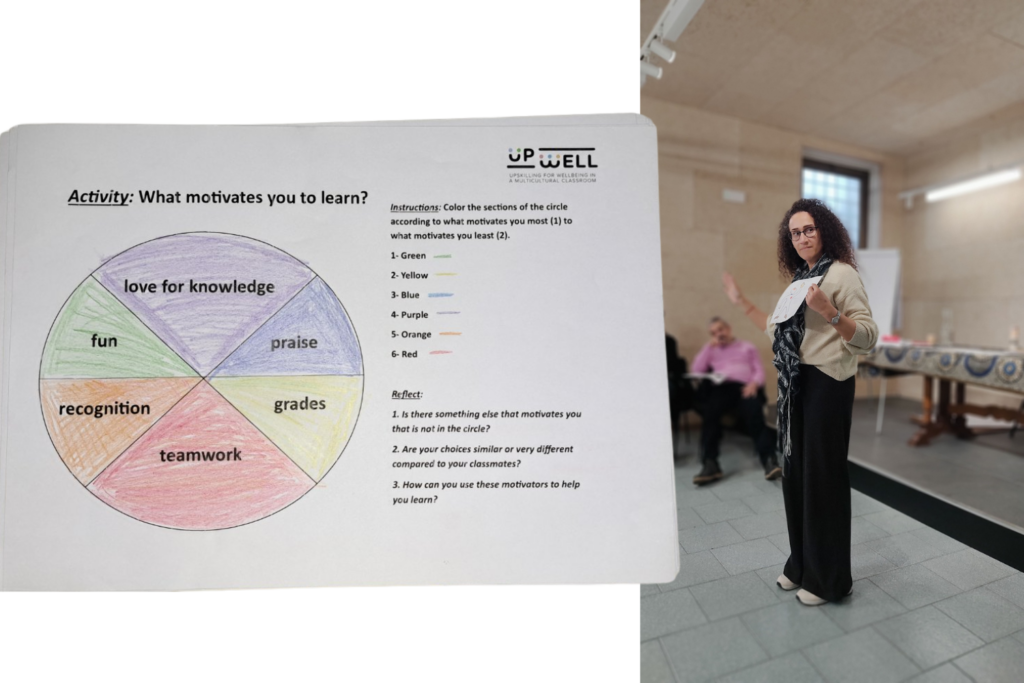
How have the inclusive approaches and methodologies presented in UPWELL impacted lesson planning or student engagement? According to teacher Themis Vasiliou (from Perifereiako Gymnasio Akakiou), among the inclusive approaches and methodologies presented in UPWELL, thanks to the language wall within her multicultural class, she experienced that motivation and wellbeing are interdependent because students felt much more confident and inspired if they are evaluated, and teachers play a vital role in this process.

How has your understanding of well-being—both personal and professional—evolved through your participation in the UPWELL project? The answer from Elizabeth Antoniadou (from Gymnasio Episkopis) is that the implementation of the activities in the curriculum could expand her teaching and make the lessons more effective and communicative. She could get a better insight into what motivates her students to learn and what obstacles they had to overcome during this process. Students opened up, thanks also being in a small group class, and so she could understand their fears and the relationships among them. All this can help all teachers, in general, to feel more aware of their teaching practices and so to adapt them to the student’s needs.

An Erasmus project, such as UWELL, can truly impact teacher’s practices and the chance to take part in this program is an opportunity that more and more teachers would need to increase their teaching approaches and their well-being. On such reflection we wanted to also ask the contribution of our ambassador, Constantinos Monos (from Lighthouse Private School), who said: “The grassroots-level positive impact among students and teachers implementing the thoughtfully designed educational interventions within the context of the UPWELL project is abundantly evident in the very own testimonies of the school communities engaged here in Cyprus. Multiculturalism is not merely a reality and an additional complexity within the educational realm, but an opportunity to relate to each other by informing our understandings, broaden our perspectives, and reiterate our commitment to purposeful, human-centred, and meaningful education. In highly contentious and divisive times, where the alienation of the “other” and conflict-oriented first-response approaches are gradually establishing themselves as the new norm… the well-being of teachers and students ought to be the one condition we safeguard with all means in our disposal”.
The most important result, as it is shown by all these testimonials, is not only the benefit of the work carried out within UPWELL, but especially bounds, connections, and friendship which were born through all the process and that will allow to build future collaborations and other fruitful projects and experiences in Cyprus and at European level.